
Ether ETPs Pose Unprecedented Risks For Investors, Markets, and the Economy
By Benjamin Schiffrin, Director of Securities Policy

This summer trading began on exchange-traded products (ETPs) tied to the price of the cryptocurrency Ether. The Securities and Exchange Commission (SEC) approved these products back in May. At that time, we warned that approving the ETPs would endanger investors given that Ether (like most cryptocurrencies) was an extremely volatile asset.
Unfortunately, it did not take long for Ether’s volatility to manifest. Ether ETPs debuted on July 23, and on July 25 Ether slid as much as 7.8%. It turns out that was only the beginning.
In early August, Ether dropped 22%, Bitcoin dropped 15%, and overall the crypto market saw $367 billion in value wiped out over a 24-hour period. Ether’s fall erased all its gains for the year. Unsurprisingly, the rapid drop in the price of Ether was described as “breathtaking.”
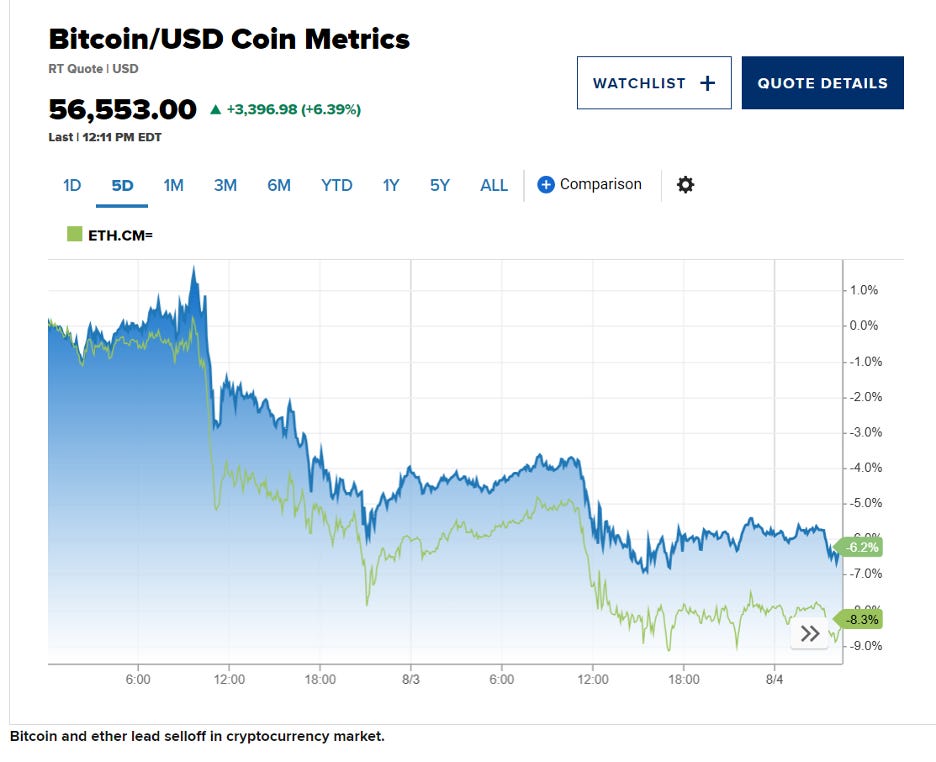
The problem now is that, with the SEC’s approval of Ether ETPs and prior approval of Bitcoin ETPs, this latest crypto selloff will be felt by a broader base of investors than previous crypto implosions. That’s because the issuers of these ETPs are well-known firms that market their products to millions of retail investors. The products themselves are investments in Ether, which makes them no less risky than investing in Ether directly, but their marketability to a much wider swath of the investing public means that many more retail investors are exposed to the risks of Ether’s volatility when collapses occur.
The even bigger danger is that integrating crypto into mainstream finance through Ether and Bitcoin ETPs means that crypto’s volatility could have ramifications for the broader economy. Prior crypto meltdowns did not spill over to other parts of our markets because the broader economy was insulated from crypto. But the more crypto seeps into traditional financial products, the greater the risk to the financial system as a whole.
We should be grateful that the collapse of FTX in 2022 did not trigger a wider financial calamity, but it should also serve as a reminder of crypto’s dangers. The turmoil in the crypto industry that culminated in FTX’s collapse caused a loss of over $2 trillion in value. Imagine if that collapse occurred with crypto fully integrated into the financial system?
Unfortunately, people have short memories. Although FTX’s collapse did not destroy the savings of most Americans, at least 15 public pension funds had at least indirect exposure to FTX and suffered losses a result. The losses were not significant enough to affect the funds’ ability to pay benefits to retirees, but it was supposed to serve as a warning that illustrated the risks for retirement funds if they embraced crypto too aggressively.
That warning has not been heeded. Instead, large financial institutions and their industry lobbyists are now engaging in a sales campaign to get state pension funds to invest in crypto ETPs. As a result, millions of former teachers, firefighters, and police officers could be exposed to the wild ups and downs of a largely unregulated financial product.
The strategy appears to be paying off as Wisconsin and Michigan have already purchased stakes in Bitcoin ETPs. The allure is that crypto offers states facing budget shortfalls the promise of sky-high profits, even as they fail to fully acknowledge the risks. We’ve already seen how it turned out for states facing shortfalls to chase risky returns by investing in private equity, and retirees in public pension funds are likely to fare no better with crypto.
The danger is especially pronounced given that the media often describes these products as ETFs, rather than ETPs, and dangerously equates them to the ETFs that have become an enormously popular way for Americans to invest their money in equities, bonds, commodities, currencies, and real estate. It is true that ETFs have become enormously popular, but that is because they allow investors to hold diversified investments in a single vehicle. Conversely, there is no diversification in an Ether ETP. The underlying investment in an Ether ETP is Ether, and only Ether. This means that, unlike with the ETFs that are owned by millions of Americans, investors in Ether ETPs are essentially investing in a single, notoriously volatile asset—just as if they were investing in Ether directly.
Crypto has always been a volatile asset with no intrinsic value, which makes it akin to a digital slot machine. If anyone has discovered an actual use case for crypto, they’ve kept it well hidden. Instead, it is used mainly to speculate or engage in criminal activity like drug dealing and collecting ransom demands. Up until recently, though, it was not part of the mainstream investing landscape. The SEC’s approval of Ether ETPs, following Bitcoin ETPs, is poised to change that, with investors facing unprecedented risks as a result.